
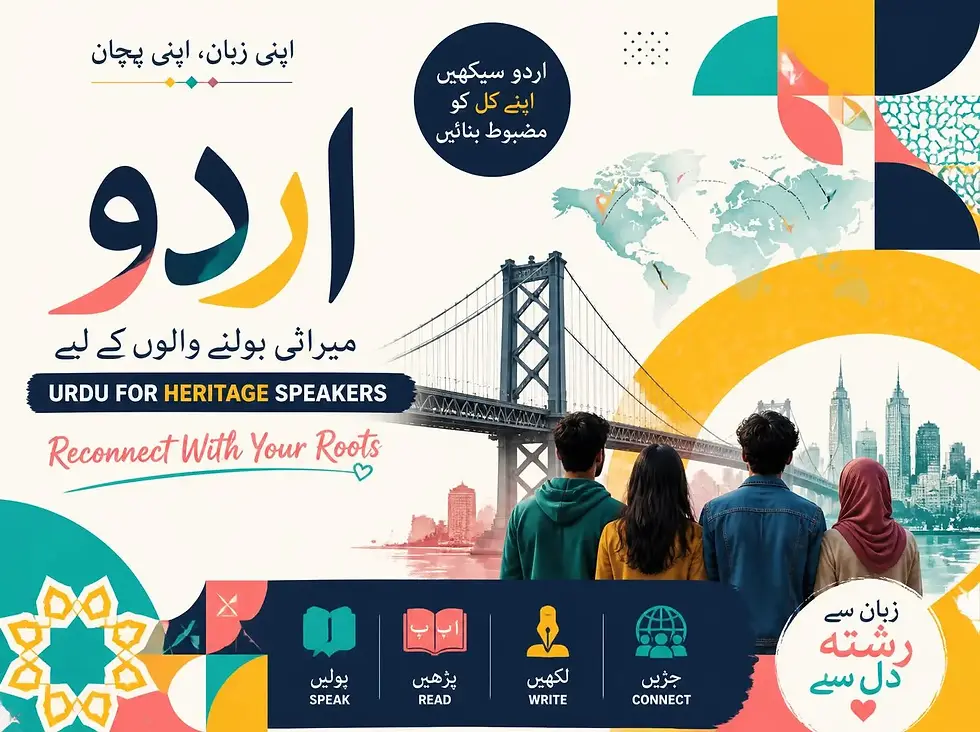
Urdu for Heritage Speakers: Reconnect With Your Roots

Urdu for heritage speakers looks nothing like a typical beginner course, and most standard classes get this completely wrong. You probably grew up hearing Urdu at home, understand far more than you can comfortably say, and feel a quiet frustration every time a family gathering reminds you how much slips away in translation. A tutor experienced with heritage learners inside proper online Urdu classes builds lessons around exactly that gap, strengthening speaking confidence rather than starting you over from the alphabet like a total beginner. Your ear already knows more Urdu than your mouth does, and the right class closes that specific distance.
Family and identity sit at the center of this journey for most heritage speakers. Grandparents who speak little English, family stories that lose meaning through translation, and a general sense of disconnection from cultural roots all push adult heritage speakers back toward formal lessons. That motivation runs deeper than a typical beginner's curiosity, and it deserves a teaching approach built specifically around it.
Shame often complicates this process too. Many heritage speakers feel embarrassed about their accent or grammar gaps in front of native speakers, especially family members who assume they should already speak fluently. A patient, understanding tutor removes that pressure entirely, treating early mistakes as normal steps rather than sources of embarrassment. That shift in tone alone often unlocks progress that years of quiet self-consciousness had blocked.
The guide below explains what makes heritage speakers different from true beginners, the specific struggles this group faces, and how a tailored class helps close the gap between understanding and speaking with real confidence.
What Makes Heritage Speakers Different From Beginners?
A true beginner starts from zero vocabulary and zero listening comprehension. A heritage speaker usually understands far more Urdu than they can produce, since years of passive listening at home built strong comprehension without matching speaking practice. That imbalance creates a specific kind of frustration unique to this group.
Vocabulary gaps also cluster in predictable places. Heritage speakers often know rich, warm vocabulary around family and food, since those topics dominated childhood conversations, while formal or abstract vocabulary remains completely unfamiliar. A generic beginner course wastes time re-teaching words a heritage speaker already knows instinctively, rather than addressing these specific gaps.
Accent and rhythm often set heritage speakers apart from true beginners too. Years of passive exposure at home usually leave a heritage speaker with genuinely native-sounding pronunciation, even if their grammar and vocabulary lag behind their accent. A tutor who recognizes this strength builds on it directly rather than starting pronunciation drills a heritage speaker simply doesn't need.
Common Struggles Heritage Speakers Face
Confidence gaps show up constantly during lessons. A heritage speaker might understand a complex sentence perfectly, then freeze when asked to construct a similar sentence out loud. Grammar rules that a formal student learns explicitly often remain intuitive but unreliable for a heritage speaker, correct in familiar phrases but shaky in new combinations.
A blend of Urdu and English mid-sentence, often called code-switching, adds another layer of complexity. That pattern feels comfortable at home but disrupts a setting that calls for full Urdu fluency. A tutor gently reduces this habit over time, encouraging complete Urdu sentences without making the process feel like correction for its own sake.
Understanding vs Speaking Confidently
Passive comprehension develops naturally through years of exposure, while active speaking requires deliberate practice that most heritage speakers never received formally. A tutor addresses this gap directly by pushing conversation practice far more heavily than vocabulary building, since vocabulary rarely represents the real bottleneck for this group.
Filling Grammar Gaps Without Starting Over
Formal grammar explanation helps heritage speakers far more than most expect, since it turns intuitive but shaky patterns into reliable, conscious rules. A tutor identifies which specific grammar points trip up a heritage speaker most often, then targets exactly those gaps instead of reviewing material the student already knows well. A targeted approach like this respects the years of exposure a heritage speaker already carries, rather than treating them like a total beginner who needs every rule explained from scratch.
How a Tailored Urdu Class Rebuilds Speaking Confidence
Conversation-heavy lessons work far better than textbook drills for heritage speakers. A tutor who understands this background pushes you into real conversation quickly, correcting specific errors as they surface rather than front-loading grammar theory you don't need. That approach respects the real skill you already carry while addressing the genuine gap that holds you back.
Script practice often rounds out a heritage speaker's Urdu in ways spoken exposure never covered at home. Many heritage speakers can hold a fluent conversation yet struggle to read a simple text message from a relative, and targeted reading and writing practice closes that gap efficiently once speaking confidence improves.
A tutor also helps a heritage speaker recognize their own accent as a genuine asset rather than something to second-guess. Years of authentic exposure at home already gave you sounds and rhythm many adult beginners spend months trying to approximate, and building fluency on top of that foundation moves faster than starting from nothing.
Building Vocabulary Beyond the Home
Household vocabulary rarely stretches into formal or professional territory. A heritage speaker who grew up discussing family and food in Urdu often has no vocabulary for work, current events, or abstract topics, simply because those conversations never happened at home in that language. Deliberate vocabulary expansion into these areas rounds out a heritage speaker's Urdu into something closer to full adult fluency, useful well beyond family gatherings alone.
Why This Journey Matters Beyond Language Alone
Fluency in Urdu opens conversations with grandparents and older relatives that translation apps and awkward gestures never fully replace. Family stories carry different weight and detail in their original language, and a heritage speaker who reaches real fluency often describes the experience as reconnecting with a part of their identity they'd quietly missed for years. The overview of heritage language on Wikipedia notes that heritage speakers often grow up more competent in a dominant language than in the one spoken at home, a gap that explains exactly why this kind of reconnection carries so much emotional weight. A patient, culturally aware tutor understands that weight and treats every small breakthrough with the seriousness it deserves.
What to Expect in Your First Few Lessons
A first session with a heritage-focused tutor usually starts with an honest conversation, not a test. A tutor asks about your comfort level, your family background, and your specific goals, then designs a starting point around that information rather than a fixed placement test built for total beginners. Early sessions typically feel more like guided conversation than formal instruction, which puts most heritage speakers at ease quickly.
Expect gentle correction rather than harsh grading during these early weeks. A good tutor treats mistakes as normal data points on the path to fluency, not embarrassing failures, and that tone alone often makes the biggest difference in how quickly a heritage speaker's confidence rebuilds.
Progress often feels faster than heritage speakers expect once lessons begin. Skills that felt shaky in isolation, like constructing a full sentence from scratch, tend to click quickly once a tutor provides the specific missing piece, whether that's a grammar pattern, a formal vocabulary word, or simply consistent encouragement to keep talking despite imperfect phrasing.
A journey back to Urdu as a heritage speaker deserves a class built specifically around your background, not a generic beginner course. Get in touch today to start lessons designed for heritage speakers, and finally match your speaking confidence to the Urdu you already understand.


Can you remove the word mirasi? Sounds very inappropriate! The correct word is moroosi.