
Best Way to Learn Urdu Online in 2026

Updated: Aug 3
A search for the best way to learn Urdu online usually leads to three main options, a language app, a group course, or private lessons with a native tutor. Each option promises results, yet each one fits a different type of learner and a different pace of progress. A wrong choice wastes months of effort and motivation. Structured, one-to-one online Urdu classes consistently produce faster, more reliable results than apps or large group settings, and an understanding of why helps you make a confident decision from the start. Real feedback from students who tried more than one approach shapes every comparison below.
You've probably already tried an app or two. Apps feel convenient and cheap, and they work reasonably well for basic vocabulary. Real conversation skill rarely develops through an app alone, since apps can't correct your pronunciation or adjust to your specific mistakes in real time. That gap becomes obvious the first time you try to hold an actual conversation with a real person.
Group classes solve part of that problem by adding a live teacher, though shared class time still limits how much individual correction and speaking practice you actually get. A room of six or eight students means your actual speaking time shrinks to a few minutes per session, and quieter students often fall behind without anyone noticing.
The comparison below covers all three approaches honestly, then explains exactly how a private, one-to-one online Urdu class delivers faster progress than either alternative.
Learning Urdu Through Apps: Strengths and Limits
Apps excel at vocabulary drills, gamified repetition, and low-pressure daily practice. You can study for five minutes on a commute or before bed, and that flexibility keeps many beginners motivated in the early weeks. Apps struggle badly with speaking practice, pronunciation correction, and grammar explanation tailored to your specific confusion. Most learners plateau quickly once vocabulary alone stops being enough to hold a real conversation.
A streak counter and a colorful badge system feel motivating at first, but neither one teaches you how to respond when a real person asks you an unscripted question. That gap between app fluency and real conversation catches most self-taught learners off guard, often after months of daily use that felt productive at the time.
Learning Urdu in Group Classes: What Actually Happens
Group classes offer structure, a syllabus, and the social motivation of learning alongside other students. A live teacher answers questions and models correct pronunciation, which already beats an app. Individual attention still gets divided across every student in the room. Shy learners often stay quiet for entire sessions, and confident speakers may dominate practice time while everyone else falls behind.
A fixed group syllabus also moves at the pace of the slowest or fastest student, rarely both at once, which leaves some learners bored and others struggling to keep up week after week. Fixed class scheduling adds another layer of friction, since a set class time rarely accommodates every student's calendar equally well.
Why One-to-One Online Urdu Classes Work Best
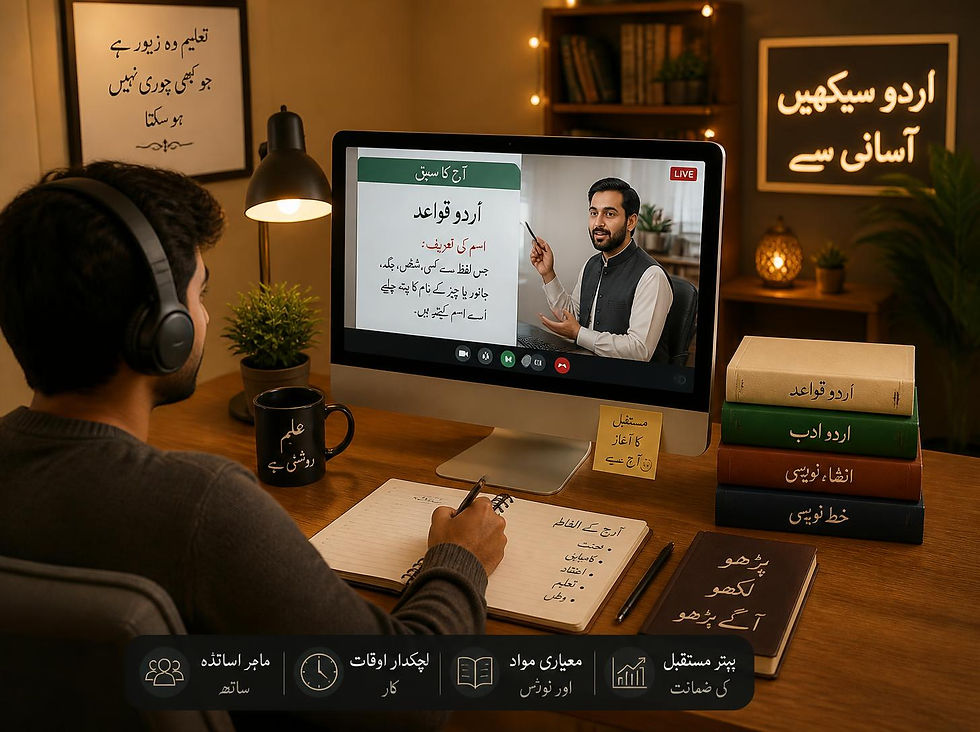
Private lessons put 100 percent of a teacher's attention on your specific mistakes, goals, and pace. A tutor adjusts every session in real time based on how you're actually progressing, rather than following a fixed group syllabus. That flexibility matters enormously for adult learners balancing work, family, and limited study time.
Consider what changes when lessons shift from group to one-to-one format.
• Every minute of class time focuses on your speaking, not shared time with classmates
• A tutor corrects pronunciation and grammar mistakes the moment they happen
• Lesson content adjusts weekly based on your actual progress and goals
• Scheduling flexes around your life instead of a fixed group timetable
• Progress becomes measurable and personal, not averaged across a classroom
Most students who switch from group classes to private lessons notice a real jump in confidence within just a few sessions, simply because they finally get to speak more than a sentence or two per class. That extra speaking time compounds week after week into a noticeably faster overall pace of progress.
What to Look for in a Private Urdu Tutor
Experience matters more than flashy marketing or a polished app interface. A tutor who has taught for decades has already seen every common mistake and knows exactly how to correct it efficiently. Native fluency also matters, since pronunciation and cultural context come across far more naturally from someone who grew up speaking the language daily.
A tutor's teaching style counts just as much as years of experience, since someone who lectures at you rather than drawing you into conversation defeats the purpose of choosing private lessons in the first place. Look for someone who asks questions, encourages you to speak often, and adapts their explanations to how you personally learn best.
Questions Worth Asking Before You Commit
Ask how lessons get structured around your specific goals, whether the tutor offers a trial class, and how progress gets tracked over time. A confident, experienced teacher answers these questions clearly and without hesitation, and hesitation on basic questions is usually a sign to keep looking.
How Much Does a Private Urdu Tutor Cost Compared to Alternatives?
Apps typically cost the least upfront, often a small monthly subscription fee, though their limited results mean many learners eventually pay for a tutor anyway after months of slow progress. Group classes sit in the middle, priced per session but split across several students, which brings down the per-person cost while also reducing per-person attention.
Private lessons cost more per hour than either alternative, yet they often prove cheaper overall once you account for total time to fluency. A learner who reaches conversational comfort in four months of private lessons frequently spends less in total than someone stuck in a slower group course for a full year. Value matters more than the sticker price alone.
A trial class helps you judge that value directly before committing to a longer course. Most experienced tutors offer one, and a single session usually makes the difference between private and group instruction obvious within the first thirty minutes of real conversation.
Making the Right Choice for Your Urdu Learning Goals
Apps suit casual dabbling or vocabulary review alongside other study methods. Group classes work for learners who value structure and social accountability over individual pace. Private, one-to-one lessons remain the fastest, most reliable path for anyone serious about real fluency within a reasonable timeframe. Global demand for Urdu instruction continues rising steadily, and the Urdu language overview on Wikipedia confirms it ranks among the most widely spoken languages in the world, spoken across Pakistan, India, and large diaspora communities worldwide.
That scale of demand means quality tutors and real learning communities exist wherever you happen to live, and the right one-to-one class connects you with exactly that kind of support.
The best way to learn Urdu online comes down to personal attention, expert correction, and lessons built around your actual life. Contact me today to book your first private class, and experience the difference real one-to-one teaching makes.



Comments